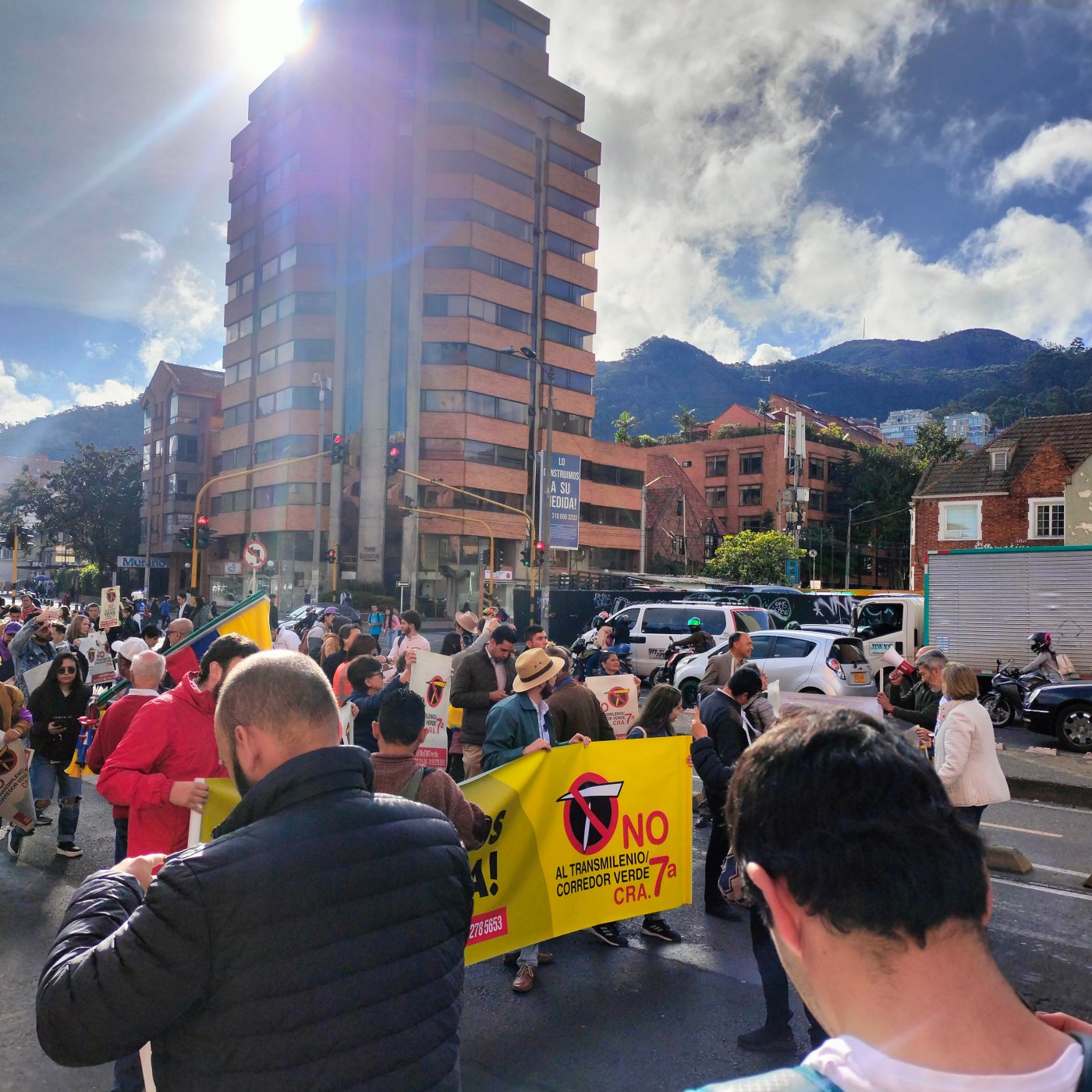
Protest against a Transport Development plan in Bogotá, Colombia. Photo by Andres Galeano.
This is a summary of the project “Strengthening Democracy beyond ‘participation’,” that I conducted between 2020-2024 and was subsidized by the VENI talent grant by the Dutch Science Organization (NWO), and the Impact Explorer project (NWO) in which I translated the findings to action repertoires for better participation (2024-2025)
This project investigated Planning Conflicts, focusing on how citizens informally claim their right to the city in ways that formal participatory urban planning processes fail to recognize, and how these informal politics interact with and shape formal participation. It addressed the democratic challenge of including citizen groups in local decision-making, particularly in complex urban development contexts where formal participation often remains partial and exclusionary.
Through comparative ethnographic case studies in Amsterdam (the Netherlands) and Bogotá (Colombia)—two cities with contrasting institutional frameworks but high ambitions for citizen participation—the research explored informal political practices in and outside formal participatory meetings, street-level encounters, and broader participation processes. The project challenges the assumption that informality in politics is primarily a Southern phenomenon and that welfare states naturally provide better citizen involvement.
The project employed political ethnography combined with stakeholder workshops to generate detailed, multi-perspective insights into informal claims-making and their effects on formal governance. It aimed to advance theory on agonistic democracy by analyzing conflict as an opportunity for democratic engagement, contribute to comparative urban studies by linking global North and South contexts, and innovate research methods by involving stakeholders in knowledge production and utilization.
The research outputs were disseminated through academic publications on participation, recognition, public encounters, and justice in Bogotá and Amsterdam, as well as professional publications on public participation, and a large variety of training sessions and municipal council advice at different municipal, provincial, and national governments across the Netherlands:
- Verloo N, Rinaudo-Velandia, M., and Tascón, J. (2026) Toward Experiential Socio-Spatial Justice: Rethinking Redistributive, Procedural, and Epistemic Approaches through Bogotá’s Fenicia Triangle. Environment and Planning A: Economy and Space. Online first.
- Bartels, K. P., Verloo, N., & Boswell, J. (2026). Public Encounters: Advancing the Study and Practice of Citizen‐State Relationships. Social Policy & Administration, 60(2), 233- 239. https://onlinelibrary.wiley.com/doi/10.1111/spol.70058
- Verloo, N. (2026). How Public Participation Depends on What Happens ‘In-Between’: Analysing Emotion, Memory and Meaning in Participatory Policies. Social Policy & Administration, 60(2), 298-309. https://doi.org/10.1111/spol.70047
- Verloo, N., & Galeano Salgado, A. M. (2025). Analyzing transport politics through ‘‘critical moments’’: Conflict and power in the paradigmatic case of Seventh Avenue in Bogotá, Colombia. Urban Studies. Advance online publication. https://doi.org/10.1177/00420980251388528
- Verloo, N. (2025). The “critical moments” when public participation falters. National Civic League, 114(3). https://www.nationalcivicleague.org/ncr-article/the-critical-moments-when-public-participation-falters/
- Verloo, N. (2023). Ignoring people: The micro-politics of misrecognition in participatory governance. Environment and Planning C: Politics and Space, 41(7), 1474-1491. https://doi.org/10.1177/23996544231182985
For Dutch public professionals:
- Verloo, N. (2025). De praktijk van erkenning: Hoe democratische professionals de participatieve en representatieve democratie kunnen verbinden. In M. Spierts, I. Verhoeven, M. van Pelt, & M. Ham (Eds.), Democratie dichterbij: De belofte van democratisch professionalisme (pp. 42-58). Van Gennep. https://vangennep-boeken.nl/product/democratie-dichterbij-professionals-die-macht-taken-en-kennis-delen?srsltid=AfmBOop7-wksT2V4ZKWUqw5NKDsYw49vVeHWsnlfxQ2ddXRTxbDLhWuM
- Boogaard, G., Hendriks, F., Tiemeijer, W., Verloo, N., Essaybundel burgerparticipatie op nationaal niveau, Den Haag: Ministerie van Binnenlandse Zaken en Koninkrijksrelaties, juli 2024. https://www.kennisopenbaarbestuur.nl/documenten/2024/07/22/essaybundel-burgerparticipatie-op-nationaal-niveau
- Verloo, N. (2023). Struikelen over participatie: Tien ‘kritieke momenten’ voor betere burgerparticipatie in lokale besluitvorming . Van Gennep. https://vangennep-boeken.nl/struikelen-over-participatie-tien-kritieke-momenten-voor-betere-burgerparticipatie-in-lokale-besluitvorming
 Small Stories to rethink Large Issues