Read the Open Access article here: Urban Studies, Online first (2025)
By invitation of the UGovern community, we wrote a blog that summarizes the findings from our Urban Studies article on Critical Moments to analyze Planning Conflict:
By Nanke Verloo and Andres Galeano Salgado.
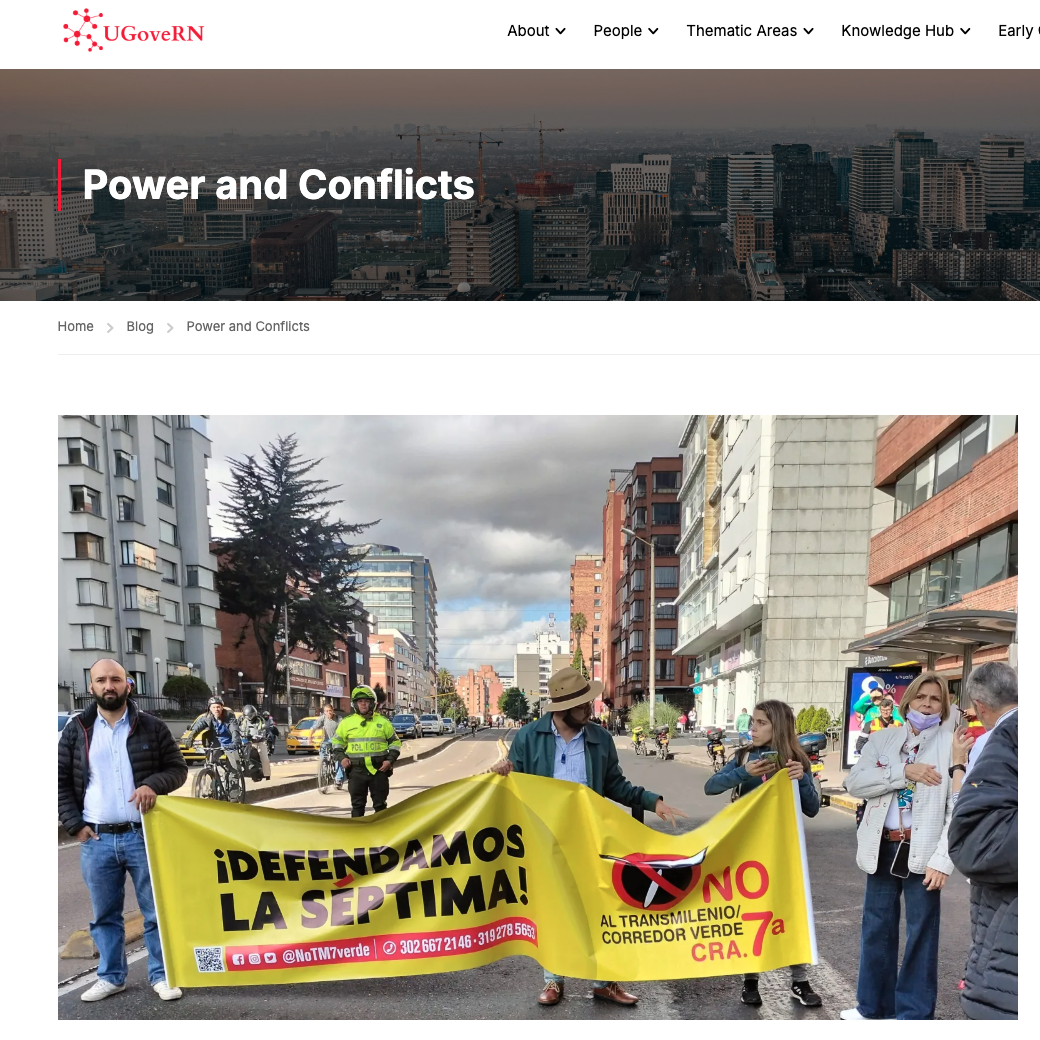
Although often approached as technical, urban developments are inherently political. Whether they concern urban regeneration, housing, infrastructure, or transport, spatial interventions mobilize citizens with local knowledge, experience, and demands that do not always align with those of administrators. Despite the widely adopted ambition to involve the public, contesting citizen groups are often ignored, excluded, or delegitimized. Our recently published paper (see the full paper in Urban Studies) proposes to use ‘Critical Moment Analysis’ to study the contentious interplay between citizens, planners and political leaders. We analyze the politics behind a progressive transport project in Bogotá, Colombia. The analysis reveals how planning agendas that aim to address justice for some, tend to simultaneously choose one voice over another, and thereby end up jeopardizing justice for all.
Whereas participation processes organized by local governments often expect citizens to voice their concerns via formal channels and highly orchestrated moments of public meetings, citizens use all sorts of informal practices to voice their stories in and outside formal participatory frameworks. To understand the interplay between these formal and informal planning politics, we introduce the methodology of Critical Moments (CMs) as a novel analytical framework to study planning conflicts. The CM framework focuses on how power dynamics and political actions shape contentious planning processes. Critical Moments reveal the complex interplay between formal governance and informal citizen action, highlighting the temporal and relational dimensions of conflict and power in urban transport decision-making. Critical moments are pivotal points in contentious processes characterized by uncertainty, disruption of existing power relations, and significant consequences that reshape stakeholders’ political action repertoires. This approach allows researchers to dissect how different actors—including government officials, planners, and various citizen groups—perceive, respond to, and influence planning processes over time, often in conflicting ways.
Continue reading our post here
 Small Stories to rethink Large Issues
Leave a comment